
There is a large gap between mowing a property and gardening it.
Most maintenance crews are equipped for volume — blow, trim, move on. That is the right service for a lot of properties. It is the wrong service for a perennial border, a mature shade garden, or a collection somebody spent fifteen years assembling.
Fine gardening is slower, by hand, and done by people who can tell a seedling from a weed before pulling it. If you have ever come home to find something you loved cut to the ground, you already know why this is a separate service.
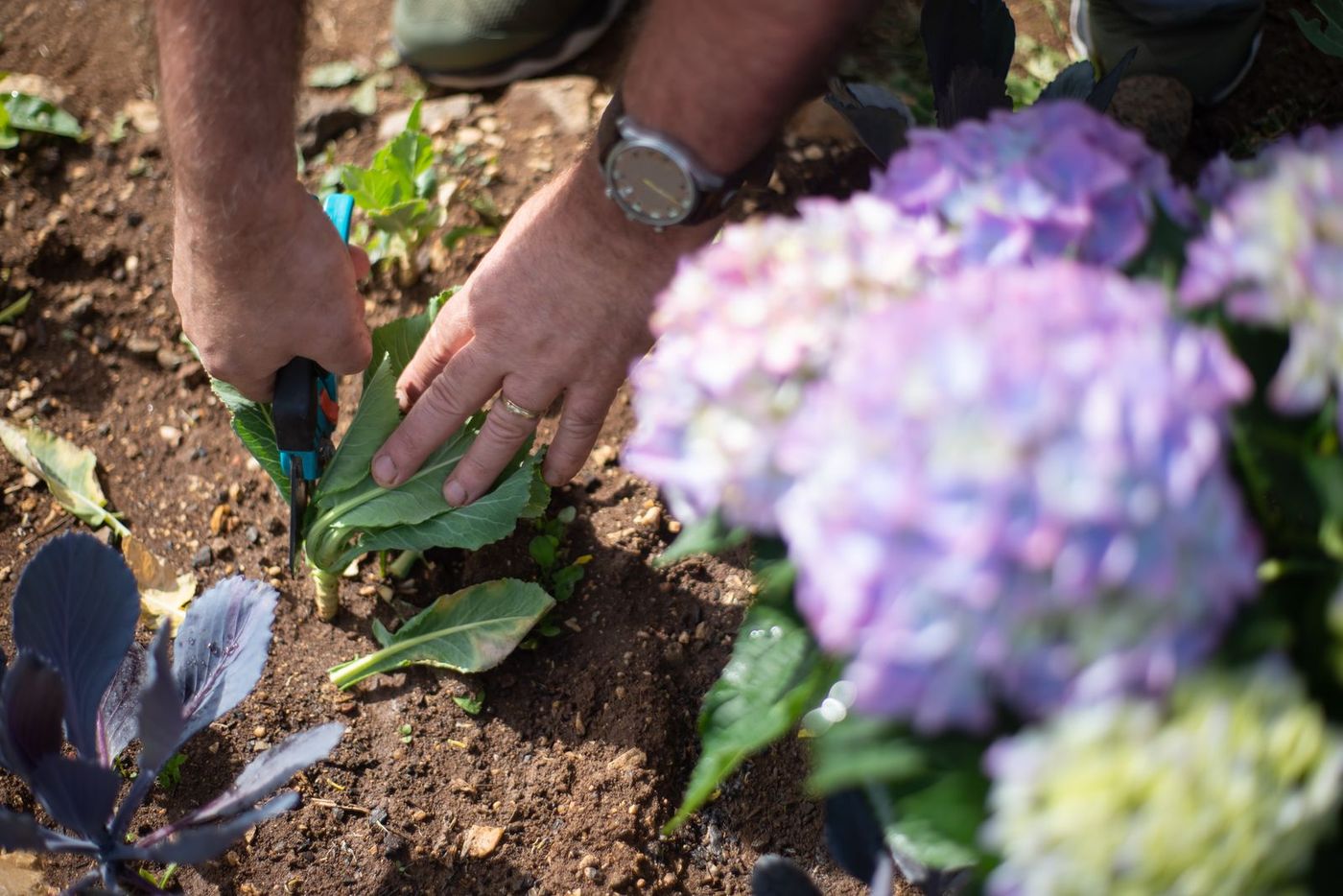
Scope, written out.
Every line below appears on your proposal, so you can hold it against anyone else’s bid.
- Hand weeding, not blanket herbicide
- Species-correct pruning at the right time of year
- Perennial deadheading and succession management
- Dividing and transplanting overgrown clumps
- Editing — removing what has outgrown its place
- Staking and support for tall perennials
- Bulb planting and seasonal rotations
- Container design, planting, and upkeep
- Soil health, compost, and top-dressing
- Bed line refinement and hand edging
- Plant health assessment and early intervention
- Replacement recommendations with a written plan
The parts you cannot see are the parts that fail.
Plant knowledge on site
The person in your beds can identify what is growing there. That is the whole service — everything else follows from it.
Right cut, right season
Spring bloomers pruned after flowering, not in March. Timing is the difference between a shrub that blooms and a shrub that just exists.
Editing, not just tidying
Mature gardens need things removed. A good gardener tells you what has outgrown its spot instead of shearing it smaller every year.
Continuity matters most here
The same gardener across seasons, who remembers what you moved last year and what you are trying to establish.
Nobody in this market will give you a number. Here is what actually moves it.
Every landscape contractor in the Twin Cities refuses to quote before seeing the site, and honestly they are right to — access and grade change a price more than square footage does. What we will do is tell you which decisions drive your number, so you walk into the consultation knowing where the money goes.
- Bed square footage and planting density
- Visit frequency — fine gardening is usually every two to four weeks in season
- Garden complexity — a mixed perennial border is many times the hand time of shrub beds
- Current condition — a neglected garden usually needs a restoration visit first
- Containers — design, material, and rotation frequency
- Soil work — compost and top-dressing across the beds
Start Your Project
Tell us about the space. We’ll walk it with you and give you an honest read on scope and range.
What Twin Cities homeowners say
Verbatim from our Google reviews. We did not write these, and we do not get to pick which ones you see on Google — so go read all of them.
“Very impressed with the work by ProScapes. I will be working with them again. Reliable, on time, and very nice work!”
“Of all the companies I called to give me an estimate, Maddi from ProScapes is the ONLY person who followed up with me. She is so conscientious, had great recommendations and took my drawings and turned them into a fabulous reality. Her team was on time, knew exactly what to do and were flexible with my suggestions while on site. They came back a year later to fix a couple of things that didn’t grow back. I recommended them to my neighbors and they too had a very positive experience.”
“We asked them to replace a deteriorating concrete block wall (which we never liked) with a wall of large natural boulders and, if they could, preserve some mature evergreens in the process, and they exceeded expectations. The outcome is beautiful and timeless.”
Six stages, and you approve before the money moves.
Consultation
A designer walks the property with you, listens to how you actually want to use the space, and flags anything structural — drainage, grade, access — before ideas get expensive.
Site analysis
Soil, sun, drainage, slope, utilities, and existing plant health. This is the stage that separates a design that works from a design that only looks good on paper.
Design
Plan drawings and material selection, with a cost range attached before anyone commits to a full construction set. You see what you’re buying.
Your review
You mark it up. We revise. Nothing gets ordered or scheduled until the plan and the number both have your signature on them.
Installation
Our crews, our equipment. Base photos before anything gets covered, site cleaned to working condition every evening, and a firm end date.
Walkthrough & warranty
We walk the finished work with you, show you how to care for it, and hand over the warranty. Then we’re available for the maintenance if you want it.
What homeowners ask.
How is this different from regular landscape maintenance?
Can you take over a garden I've been maintaining myself?
Will you remove plants without asking?
Do you plant annuals and containers?
Related residential services
Let’s walk the space.
Consultations are free and unhurried. Bring photos, a Pinterest board, or just the problem you keep looking at — we will tell you honestly what it takes to fix.